Our Services
Our experienced engineers will conduct a thorough investigation, not just of the inverter but of your whole system
to pinpoint where the problem is and get it resolved as quickly as possible.
Sometimes the inverter just can't be fixed or its not cost effective to do so. If this is the case & the
inverter is still within it's manufacturers warranty, we will ensure that all the necessary details are available
for you to claim back directly from the manufacturers. If the warranty has expired then we can assess your
solar PV system using a Solar Design Program which calculates the best replacement inverter for you by reviewing
all kinds of factors including the location of your home and the number and positioning of your panels.
Click here to see our Solar Panel Maintenance services
Get in Touch
Common Brands of inverters
We can work with nearly all brands of inverter but we are most familiar with the following brands
- Growatt
- ABB
- Afore
- Goodwee
- Eversola
- Chint
- Solax
Common solar PV inverter fault codes and manuals
Every solar PV system has at least one inverter. Most have a large unit found typically in the loft or garage in domestic
properties, or in the plant / electrical room or on the roof in commercial properties. If your system has stopped
generating and you have access to your inverter, its worthwhile checking to see if there is a fault code on the inverter.
The guide below helps you to understand the various inverter fault codes. Most faults fall within 4 different categories.
Grid faults, DC Insulation faults, Internal component faults & communication errors.
Firstly, we go into a little detail on each of the 4 faults. Then we have a list of the most common fault codes in Solis,
SMA, Fronius, Aurora ABB and Growatt inverters. There is not much a homeowner can do apart from a hard restart, most
faults require a solar engineer to test the system and try to rectify the issue. If your inverter / fault code is
not on our list, check the fault code in the models user guide and hopefully, you will be able to tell which category
it falls in.
Cause: The voltage from the national grid to the inverter is too high or low.
Symptoms: The inverter may display an error code and temporarily / permanently stop converting power.
Solution: First, it is important to see in the voltage is too high or low, or there is an error in the inverter
which means it’s measuring the voltage incorrectly.
A solar PV engineer will need to check the voltage coming from the grid connection at the inverter and ensure the voltage
and frequency are within acceptable limits (In the UK it’s between 207V and 253V).
If it’s found to be a fault with the grid, the local power network operator will need to be informed. They will general
put a monitoring device in the building to measure the voltage and adjust it if required.
If the fault is with the inverter, the PV engineer will need to determine whether it can be resolved using a software
update / patch or if the inverter needs to be replaced.
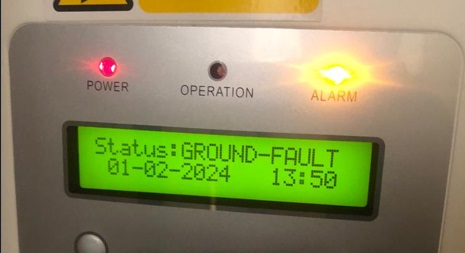
2. DC Insulation Faults / Earth Faults / Ground Faults/ Riso
Fault
Cause: These faults occur when there is an issue with the DC side of the system (damaged panels, connectors under
the panels or the cabling which connects the panels together). The most likely causes for this is either pests (pigeons,
squirrels etc) or storm damage.
Symptoms: The inverter may completely stop working and display a fault code. Often the system will only stop
working in wet weather as moisture makes contact with the break in the circuit.
Solution: Firstly, a PV engineer will need to test the system to make sure that there really is a DC fault. If
there is, a solar roofing team will need to inspect the DC wiring and connectors for damage or moisture ingress and
repair or replace any faulty components. As you are lifting panels, scaffolding will nearly always be needed.
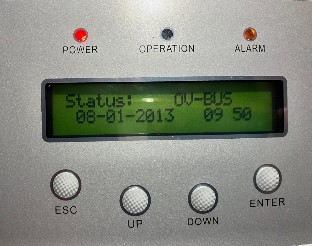
Cause: Failure of one of the internal components
Symptoms: The inverter will stop working and often display an error code.
Solution: Try a hard restart of your system (switch off AC/DC, Wait for 10 minutes and then switch on DC/AC). If
that doesn’t work, you will need a solar engineer to visit and possibly a new inverter.
4.
Communication Errors
Cause: Communication errors can occur due to faulty cables, incorrect settings, or interference.
Symptoms: The inverter may not be able to communicate with monitoring systems or other devices.
Solution: Verify the communication cables and settings. Ensure there are no sources of interference nearby. If
you have changed your router, then pair the inverter with the internet again. If none of this works its worthwhile
contacting the manufacturers for assistance.
Inverter Fault Codes
Below is a list of fault codes from different manufacturers. The Rayotec category section corresponds with the 4
types of fault listed above.
- Solis Inverter Fault Codes
-
| Fault Code
|
Rayotec Category
|
Fault Description
|
| ACVI |
1. Grid Faults |
AC Voltage Imbalance
|
| OV-G-F01/02
|
1. Grid Faults |
Over Grid Voltage |
| UN-G-V01/02
|
1. Grid Faults |
Under Grid Voltage
|
| OV-DC
|
2. DC Insulation Faults |
Over DC Voltage |
| GF |
1. Grid Faults |
Grid Fault |
| OV-bus |
3. Internal Faults |
Internal component faults |
| NO-GRID |
1. Grid Faults |
Grid Fault |
| RelayChk-FAIL |
3. Internal Faults |
Internal component faults |
| LCD show initializing
|
3. Internal Faults |
Internal component faults |
-
Fronius
Inverters Fault Codes (GALVO, PRIMO, SYMO, IG & IG+)
-
| Fault Code
|
Rayotec Category
|
Fault Description
|
| State 101 |
1. Grid Faults |
Grid Voltage is Not Within the Permitted Limits
|
| State 102 |
1. Grid Faults |
Voltage too high |
| State 103 |
1. Grid Faults |
AC Voltage too low |
| State 104 |
1. Grid Faults |
AC Voltage not in range |
| State 105 |
1. Grid Faults |
AC frequency too high |
| State 106 |
1. Grid Faults |
AC frequency too low |
| State 107 |
1. Grid Faults |
No AC Grid detected |
| State 108 |
1. Grid Faults |
Islanding detected |
| State 112 |
1. Grid Faults |
Fault current in inverter |
| State 202 |
2. DC Insulation Faults |
Current too high at DC |
| State 301
|
1. Grid Faults |
Current too high at AC
|
State 302
|
1. Grid Faults |
AC current too high |
| State 306 |
2. DC Insulation Faults |
Power low at panels |
| State 307 |
2. DC Insulation Faults |
DC low at panels |
| State 401 |
4. Communication Faults |
Communication issue with power stage set |
| State 426 |
3. Internal Faults |
Possible internal hardware fault |
| State 427 |
3. Internal Faults |
Possible internal hardware fault |
| State 428 |
3. Internal Faults |
Possible internal hardware fault |
| State 431 |
3. Internal Faults |
Software Fault |
| State 447 |
2. DC Insulation Faults |
Insulation Fault |
| State 457 |
1. Grid Faults |
Grid relay issue |
| State 509 |
2. DC Insulation Faults |
Not enough power from panels in the past 24 hours |
| State 522 |
2. DC Insulation Faults |
Voltage from the PV panels is too low |
| State 523 |
2. DC Insulation Faults |
Voltage from the PV panels is too low |
-
SMA Sunnyboy Inverters Fault Codes 2000HF / 2500HF /
3000HF
-
| Fault Code
|
Raytoec Category
|
Fault Description |
| E1 |
2. DC Insulation Faults |
Ground Fault |
| E2 |
1. Grid Faults |
Isolation Fault |
| E3 |
1. Grid Faults |
High Temperature |
| E4 |
1. Grid Faults |
Grid Fault |
| E5 |
1. Grid Faults |
Over Voltage |
| 64xx |
3. Internal Faults |
Interference Device |
| 3501 |
2. DC Insulation Faults |
Insulation Resistance |
| 1302 |
1. Grid Faults |
Grid Fault |
-
SMA SunnyBoy TL Series Inverter fault codes
-
| Fault Code
|
Rayotec Category
|
Fault Description
|
| 101 |
1. Grid Faults |
The grid voltage or grid impedance at the connection point of the inverter is too high. The inverter
has disconnected from the utility grid.
|
| 102 |
1. Grid Faults |
The grid voltage or grid impedance at the connection point of the inverter is too high. The inverter
has disconnected from the utility grid.
|
| 103 |
1. Grid Faults |
The grid voltage or grid impedance at the connection point of the inverter is too high. The inverter has disconnected from
the utility grid.
|
| 202 |
1. Grid Faults |
The utility grid has been disconnected, the AC cable is damaged or the grid voltage at the connection point of the inverter
is too low. The inverter has disconnected from the utility grid.
|
| 203 |
1. Grid Faults
|
The utility grid has been disconnected, the AC cable is damaged or the grid voltage at the connection point of the inverter
is too low. The inverter has disconnected from the utility grid.
|
| 205 |
1. Grid Faults
|
The utility grid has been disconnected, the AC cable is damaged or the grid voltage at the connection point of the inverter
is too low. The inverter has disconnected from the utility grid.
|
| 301 |
1. Grid Faults
|
The ten-minute average value of the grid voltage is no longer within the permissible range. The grid voltage or grid impedance
at the connection point is too high. The inverter disconnects from the utility grid to maintain
power quality.
|
| 302 |
1. Grid Faults
|
The inverter has reduced its power due to a too-high grid voltage to ensure grid stability.
|
| 401 |
1. Grid Faults
|
The inverter has disconnected from the utility grid. A stand-alone grid or a very large change in the power frequency was
detected.
|
| 404 |
1. Grid Faults
|
The inverter has disconnected from the utility grid. A stand-alone grid or a very large change in the power frequency was
detected.
|
| 501 |
1. Grid Faults
|
The power frequency is not within the permissible range. The inverter has disconnected from the utility grid.
|
| 601 |
1. Grid Faults
|
The inverter has detected an excessively high proportion of direct current in the grid current.
|
| 701 |
1. Grid Faults
|
The power frequency is not within the permissible range. The inverter has disconnected from the utility grid.
|
| 3301 |
2. DC Insulation Faults |
There is not enough power at the DC input of the inverter for stable operation. The inverter
cannot connect to the utility grid.
|
| 3401 |
2. DC Insulation Faults
|
The DC input voltage connected to the inverter is too high.
|
| 3402 |
2. DC Insulation Faults
|
The DC input voltage connected to the inverter is too high.
|
| 3407 |
2. DC Insulation Faults
|
The DC input voltage connected to the inverter is too high.
|
| 3501 |
2. DC Insulation Faults
|
The inverter has detected a ground fault in the PV array. As long as the fault exists, the inverter
will not feed in.
|
| 3801 |
2. DC Insulation Faults
|
Overcurrent at the DC input. The inverter briefly interrupts feed-in operation.
|
| 3802 |
2. DC Insulation Faults
|
Overcurrent at the DC input. The inverter briefly interrupts feed-in operation.
|
| 3805 |
2. DC Insulation Faults
|
Overcurrent at the DC input. The inverter briefly interrupts feed-in operation.
|
| 3902 |
2. DC Insulation Faults
|
The PV array voltage is too low.
|
| 3903 |
2. DC Insulation Faults
|
The PV array voltage is too high.
|
-
Aurora, ABB, Fimer & Power-One Inverters Fault Codes
-
| Fault Code
|
Rayotec Category
|
Fault Description
|
| E001 |
1. Grid Faults |
Isolation fault |
| E002 |
1. Grid Faults |
Grid Voltage Out of Range
|
| E003 |
1. Grid Faults |
Grid Frequency Out of Range
|
| E004 |
1. Grid Faults |
High Temperature |
| E005 |
3. Internal Faults |
Fan Failure |
| E018 |
3. Internal Faults |
Leak Fault |
| E021 |
3. Internal Faults |
Internal component failure |
| E025 |
2. DC Insulation Faults |
RISO Low |
| E031 |
3. Internal Faults |
Relay error |
| W003 |
1. Grid Faults |
Grid Fault |
| W010 |
3. Internal Faults |
Fan Fault |
-
Growatt Inverters Error / Fault Codes
-
| Fault Code
|
Rayotec Category
|
Fault Description
|
| E001 |
3. Internal Faults |
Internal error |
| E008 |
1. Grid Faults |
AC error |
| 100 |
1. Grid Faults |
Voltage fault |
| 101 |
4. Communication Faults |
Communication error |
| 102 |
3. Internal Faults |
Sampling error |
| 111 |
3. Internal Faults |
IGBT drive fault |
| 116 |
3. Internal Faults |
EEPROM fault |
| 117 |
3. Internal Faults |
Relay fault |
| 118 |
3. Internal Faults
|
Init model fault |
| 119 |
3. Internal Faults
|
GCFI device damage |
| 120 |
3. Internal Faults
|
Current sensor fault |
| 122 |
1. Grid Faults |
Growatt Bus voltage too high |
| 129 |
1. Grid Faults |
Grid under voltage |
| 130 |
1. Grid Faults |
Grid over voltage |
| PV Isolation Low |
2. DC Faults |
DC Isolation fault |
| Growatt inverter no AC connection |
1. Grid Faults |
No power from grid |
| No power output |
1. Grid Faults |
No power from grid |
| Low power output |
1. Grid Faults |
Low power from panels |
| Ground Fault |
1. Grid Faults |
Earth Fault |
| AC V Outrange |
1. Grid Faults |
AC Voltage out of range |
| AV F Outrange |
1. Grid Faults |
AC Frequency out of range |
| Growatt PV isolation low |
2. DC Insulation Faults |
Insulation problem |
| Output high DCI |
2. DC Insulation Faults |
Output current DC offset too high |
Residual 1 high 201
|
2. DC Insulation Faults |
Leakage current too high |
| PV Voltage High Error 202
|
2. DC Insulation Faults |
The DC input voltage exceeds the maximum tolerable value
|
| PV Isolation Low Error 203
|
2. DC Insulation Faults |
Insulation Problem |
AC V Outrange Error 300
|
1. Grid Faults |
Grid Fault |
No AC connection Error 302
|
1. Grid Faults |
No AC Connection (Check fuse box) |
Warning 203
|
3. Internal Faults |
Internal component faults |
| Warning 204 |
3. Internal Faults |
Dry connect function abnormal |
| Warning 205 |
3. Internal Faults |
Internal component faults |
| Warning 404 |
3. Internal Faults |
EEPROM abnormal |
| Error 402 |
3. Internal Faults
|
Output high DCI |
| Error 404 |
3. Internal Faults
|
Bus sample fault |
| Error 405 |
3. Internal Faults
|
Relay fault |
| Error 408 |
3. Internal Faults
|
Over temperature |
| Error 409 |
3. Internal Faults
|
Bus over voltage - DSP communicates with M3 abnormal |
| Error 411 |
3. Internal Faults
|
DSP communicates with M£ abnormal EEPROM fault |
| Error 414 |
3. Internal Faults
|
EEPROM fault |
| Error 417 |
3. Internal Faults
|
The data sampled by the DSP and redundant M3 is not the same
|
| Error 420 |
3. Internal Faults |
GFCI fault |
Common inverter models
- Solis Inverter Models
-
- Fronius Inverter Models
-
- SMA Inverter Models
-
-
Aurora, ABB, Fimer & Power-One
Inverter Models
-
- Growatt Inverter Models
-
Frequently Asked Questions
What our customers most commonly ask us about our Solar PV service
- Where would I find my solar inverter?
- For domestic properties, the most common place to find your solar inverter is in the garage, loft or under the
stairs. For commercial properties, the inverter is typically in the plant room, riser or electrical cupboard.
The inverter can sometimes be on the roof if its flat.
- Do all solar PV systems have an inverter?
- All solar systems have an inverter but some may have microinverters which are found underneath the solar panels.
The most popular brand in the UK is Enphase.
- How likely it is that fault will be on the roof?
- It is more likely the fault will be with the inverter than on the roof. The most common reasons for rooftop faults
are pigeons nesting under the panels or mechanical damage after a storm. Often the inverter will have an
error code that will say something like “DC Fault” or “IR Fault”. Common symptoms of a roof fault is when
the system stops working in wet weather or if the system is generating half of what it should. The only way
to be sure is for a solar PV engineer to perform tests on each of the strings of the solar panel. This can
be done at the inverter.
- How long should a solar inverter last for?
- Most inverters come with a minimum 5 year warranty from the manufacturer. As a rough guide, older models tend
to have a lifespan of about 10 years where newer inverters probably have a life expectancy of about 15 years.
- Does a faulty solar inverter have to replaced by exactly the same model?
- No, but it’s important to run the system through a solar sizing software to make sure that the new inverter will
work at maximum efficiency and produce the maximum amount of electricity over the year. Rayotec will run
every system through a solar sizing program to confirm suitability before installing a new inverter (many
other solar companies do not do this as the software is expensive and requires training to use).
- If I change my solar PV inverter, will I lose my feed in tariff?
- No, you will not lose your feed in tariff or need to inform MCS or your energy company. If you change your generation
meter you will need to inform your energy supplier and provide photos of the old and new meter clearly showing
the serial number.
- Is it always worthwhile repairing an inverter rather than replacing it?
- Sometimes it makes more sense to replace an inverter rather than repair it. This is particularly the case with
domestic inverters. Some inverters are impossible to repair due to the lack of spare parts or absence of
technical backup from the manufacturers.
- Which inverters are the most repairable?
- SMA and Fronius inverters are generally the inverters with the best supply of spare parts.
- Can I send my solar inverter to Rayotec for repair?
- No, we will only repair an inverter onsite (if possible).
- Do you have to replace an inverter with the same make / model?
- No, but it’s important to run the system through a solar sizing software to make sure that the new inverter will
work at maximum efficiency and produce the maximum amount of electricity over the year. Rayotec will run
every system through a solar sizing program to confirm suitability before installing a new inverter (many
other solar companies do not do this as the software is expensive and requires training to use).
- My solar installation company has gone bankrupt, is my solar inverter warranty still valid?
- Absolutely, nearly all inverters come with a 5-10 years manufacturer’s warranty. This is independent of the installation
company.
- I’ve been told that my old solar PV inverter is a fire hazard, is that true?
- Unfortunately, there are a few “hard sell” solar companies that offer to visit your home and inspect your system
for free. When they are in your house they will lie and say that the old inverter is a fire hazard and try
to sell an overpriced, new inverter. If you are unsure then please contact us and we
will be happy to help
- When is better to have an inverter replacement rather than repair?
- Often, it is not cost effective to repair smaller / domestic solar inverters. Also, very old inverters may not
be worthwhile repairing due to the likelihood of additional faults developing.
- Do you have to tell MCS when you have an inverter replacement?
- No, it is not necessary to tell MCS if your inverter is being replaced. It is however very important to send
details if the generation meter is being changed and you are receiving Feed in tariff /FIT payments.
- Will a new inverter generate more energy than an older inverter?
- Even though newer inverters are slightly more efficient than older inverters, the difference is minimal so you
will not see much of a difference. If you replace a string inverter with microinverters or SolarEdge you
will see an improvement if part of the solar array is shaded.
- What areas does Rayotec Cover?
-
Commercial systems: We cover the South East, Greater London, the Midlands, and Bristol &
Bath for PV and the Southeast and London for commercial solar heating systems.
Domestic Systems: Solar PV and thermal systems, we cover Surrey, Hampshire, Middlesex, Sussex,
Berkshire & most of Kent. Usually, we only cover the boroughs of Richmond, Wimbledon, Putney
and the Croydon area in London.
Please write to us if you are just outside the areas we cover, as sometimes we may be in the locality, and
we can arrange an appointment.
We are in the process of producing more information pages about each area we cover. To learn more about what we offer check
out our pages about your area. The list is still a work in progress so if you don't see your area yet please
feel free to contact us to find out more information.
Solar Servicing in London, Solar Servicing in Surrey,
Solar Servicing Berkshire, Solar Servicing Hampshire,
Solar Servicing Sussex
Did you know we also supply and install electric underfloor heating?
Check out what we offer on the links below:


